


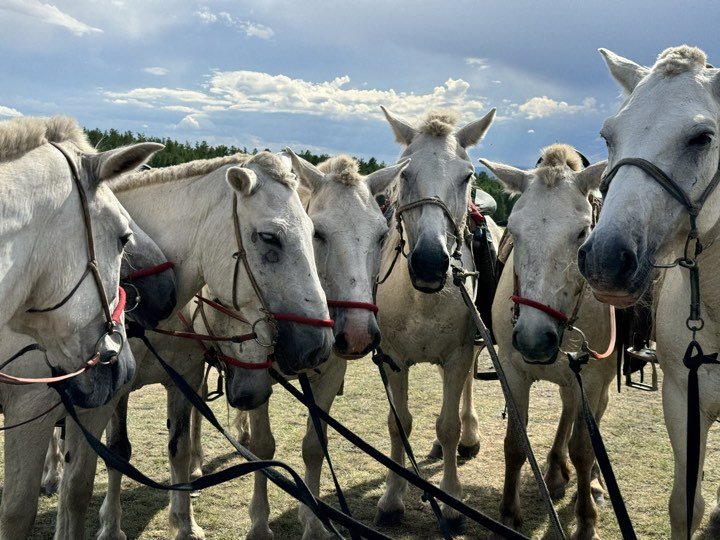
This breed of horse has flourished since ancient times in the extreme taiga conditions of the Khövsgöl-Sayan mountains, at elevations of 2,300–2,500 meters. In this region, winter snow reaches depths of 40–60 cm, and temperatures plummet to -50 °C. These horses are raised and bred entirely on open pastures.
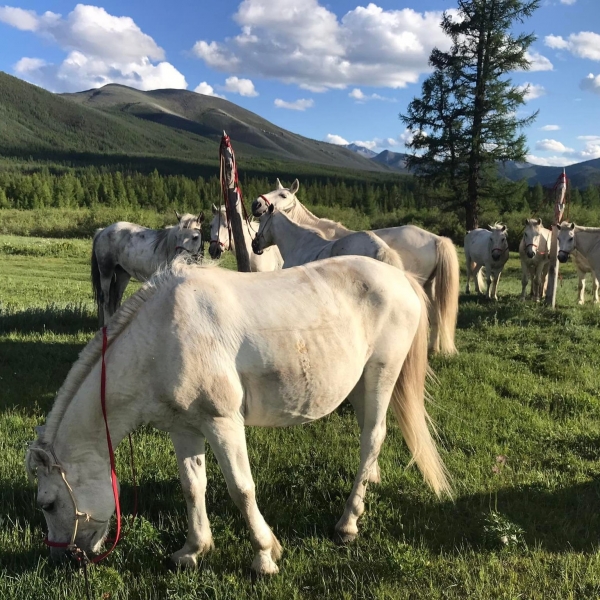
The Darkhad horse is renowned for its exceptional endurance, great physical strength, and ability to withstand heavy riding and labor. They are hardy, robust animals with high-quality hooves. Their color is predominantly white or grey. Physically, they feature broad chests, long bodies with well-developed musculature, thick skin, and dense manes and tails, making them perfectly suited for riding and transport.
Physical Measurements:
Breeding Stallions: Height at the withers is 129–132 cm; body length is 137–139 cm; chest circumference is 167–172 cm; and weight is approximately 340 kg.
Mares: Height at the withers is 127–129 cm; body length is 134–136 cm; chest circumference is 160–163 cm; and weight is approximately 360 kg.
Another unique characteristic of the Darkhad horse is its milk yield, which surpasses that of other breeds. For instance, while a standard Mongolian mare yields 300–350 ml per milking, a Darkhad mare yields 500–800 ml. Today, the core breeding herd resides in the Khatgal, Ulaan-Uul, and Renchinlkhümbe sums (districts) of Khövsgöl Province, where efforts are underway to increase their population.
A Historic Journey to the South Pole
A remarkable historical event illustrates the endurance of the Darkhad horse. At the beginning of the last century, Western scientists and geographers were locked in a race to reach the South Pole. In 1911, an English expedition led by Captain Robert Falcon Scott aboard the Terra Nova prepared to claim Antarctica. Meanwhile, Roald Amundsen of Norway was secretly preparing his own expedition aboard the Fram.
To gain a time advantage, Robert Scott chose a combination of motor sledges, snow dogs, and cold-resistant Mongolian horses. Scientists offer various theories as to why the British chose Mongolian horses for such a brutal journey. After considering horses from Northern Siberia, Buryatia, and Yakutia, they ultimately decided on the Mongolian breed.
The white horses of the Mongolian taiga are powerful animals capable of pawing through deep snow to find grass, maintaining their sense of direction in blizzards, and easily pushing through snowdrifts as high as a human waist. This lineage, forged by natural selection, still exists in Khövsgöl today. The Darkhad horse has the stamina to gallop through the piercing frost of the "Nine Nines" (the peak of winter) and face blinding snowstorms head-on. Folk songs even exist praising their courage.
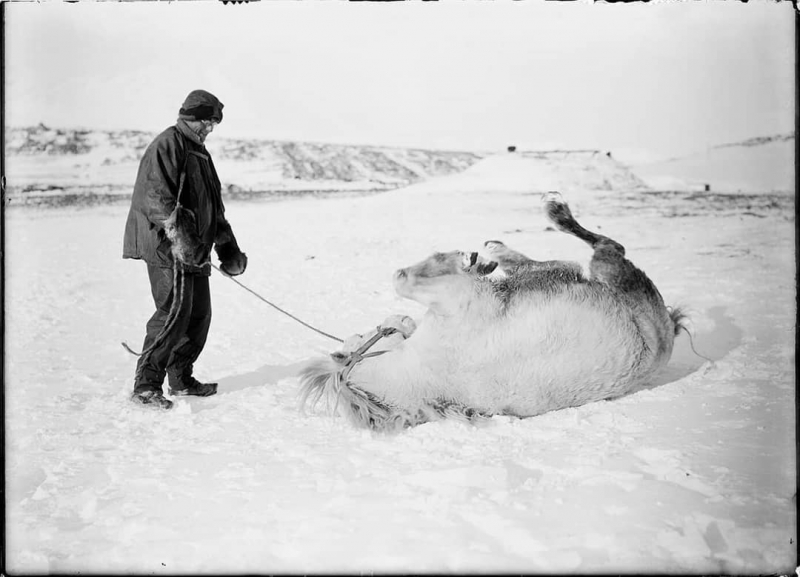
Captain Robert Falcon Scott with one of the Mongolian horses during the Terra Nova Expedition (1910–1913).
The choice of these horses proves that even before modern communication, the legend of the Mongolian horse's strength had reached the West. The British kept about a dozen horses from Mongolia in special stables, preparing them in every way for the arduous journey.
While Amundsen’s Norwegian team successfully reached the Pole in December 1911 using dogs, Scott’s team faced immense hardship due to food shortages and mechanical failures with their motor sledges. Despite this, the team reached their goal, only to find a letter from Amundsen, who had arrived a month earlier. Thus, a century ago, the Mongolian horse took part in one of the world's great geographical discoveries, carving the path for humanity toward the South Pole.
That same resilient lineage—the powerful, white-coated horses of the North—still exists in the Khövsgöl taiga today. When you join a Boojum Expeditions, you aren't just taking a trail ride. You are riding the descendants of the explorers' choice. You are sitting atop the same strength and spirit that "carved the path for humanity toward the South Pole."
